
Paid Media (PPC)
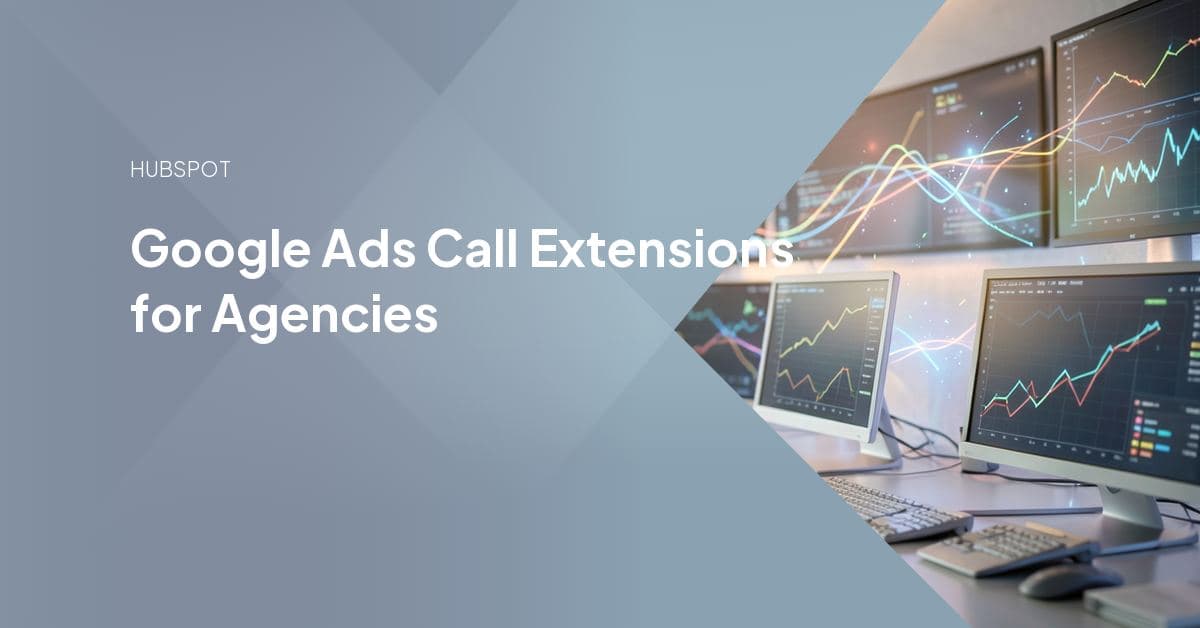
Google Ads Call Extensions for Agencies
How agencies deliver and track Google Ads call extensions (call assets) for clients under their own brand, white-label PPC from a Diamond HubSpot partner.
Key Takeaways
- Call extensions, now called call assets in Google Ads, add a phone number and tap-to-call button to a search ad, and a click-to-call is billed the same as a standard ad click.
- Agencies should confirm who actually answers a client's phone before turning on call assets, then choose account-level or campaign/ad-group-level number placement depending on how many locations or services the client runs.
- Scheduling call assets to match a client's real business hours matters because an off-hours click-to-call still bills even when it lands in voicemail and the caller moves to a competitor.
- Closed-loop reporting that ties calls to sales outcomes inside HubSpot is what turns a call-asset report into a retainer-renewal story instead of a vanity metric.
- 73% of in-house marketing teams now keep PPC fully in-house, up from 44% two years earlier, per a March 2026 Search Engine Land survey: a capacity gap white-label PPC partners are built to fill.
Google Ads call extensions, now labeled call assets inside the Google Ads interface, attach a client's phone number and a click-to-call button directly to their search ads. For an agency, they're one of the fastest wins you can ship on a paid-search account: they lift click-through rate, capture high-intent callers before a competitor does, and give you a hard conversion to report on. This guide covers how we deliver call assets across a client roster, not just how to toggle them on.
If you sell paid search but don't run every account yourself, this is exactly the kind of execution detail that separates a polished deliverable from a set-and-forget campaign.
What are Google Ads call extensions?
Call extensions (call assets) show a client's phone number alongside their ad and, on mobile, add a tap-to-call button next to the ad copy. A click-to-call is billed the same as a standard ad click, and if call reporting is enabled, calls surface as conversions in the client's reports.
The value proposition for the businesses you manage is simple: you remove a step for a searcher who is already looking to make contact. Instead of clicking through, hunting for a contact page, and possibly bouncing to a competitor, they call from the results page. For service businesses (home services, clinics, restaurants, legal) that phone call often is the conversion.
Why call assets belong in the accounts you manage
Call assets earn their place because they improve two things agencies get judged on: ad prominence and lead volume. A richer, more useful ad tends to perform better in the auction, and a phone lead is usually a warmer, faster-closing lead than a form fill.
In our delivery work, we treat asset coverage as part of ad quality, not a nice-to-have. Google's Quality Score factors into both where a client's ads land and what each click costs, so the more relevant, complete assets an ad carries, the more room you have to compete without simply bidding higher. Call assets are one of the cheapest ways to make a client's ad more complete.
They're also an easy line item to show in a report. When a client asks "what did you change this month," "we turned on call tracking and drove real phone leads" is a far better answer than a chart of impressions.
How we deliver call assets across a client roster
At scale, call assets are a checklist item in account setup, not a one-off task. Our standard delivery motion looks like this:
- Confirm the phone reality first. Before adding a number, we ask who answers it, when, and where those calls go. A call asset is only as good as the human (or system) on the other end.
- Decide account vs. campaign vs. ad-group level. For a single-location client, an account-level number is fine. For multi-location or multi-service clients, we push numbers down to the campaign or ad-group level so the right line rings for the right search.
- Turn on call reporting and a Google forwarding number so calls can be counted as conversions.
- Set a minimum call length that qualifies as a conversion, so a two-second misdial doesn't inflate the numbers you report.
Documenting this as a repeatable step means a junior team member or a white-label partner can execute it the same way on every account, and your client-facing team always knows what "call assets are live" actually includes.
Schedule call assets around the client's real availability
The most common mistake we clean up on inherited accounts is call assets running 24/7 for a business that doesn't answer the phone 24/7. Every off-hours click-to-call still bills you, even when it lands in voicemail and the caller moves on to a competitor.
Use ad scheduling on the call asset to match the client's actual coverage. Two examples we walk clients through:
- A locksmith who doesn't take overnight service calls should turn the call asset off overnight. A 2 a.m. caller needs help now; if it goes to voicemail, you've paid for a lead the client can't serve.
- A restaurant advertising pizza delivery shouldn't surface calls (or ads) outside kitchen hours. The intent is immediate, so a call the client can't fulfill is wasted spend.
Setting this up is part of the account hygiene we bake into a retainer. It's a small toggle, but for a client watching their cost-per-lead, it's the difference between a phone line that pays and a phone line that leaks budget.
Call tracking and closed-loop reporting
Enable call conversions from the start, then link the client's Google Ads and Analytics accounts so calls flow into the same conversion reports as clicks. For calls originating outside the ad (organic, direct, referral) a vanity tracking number or a service like CallRail lets you attribute phone leads by source, which is what turns "we got calls" into "here's where the calls came from."
The reporting that actually keeps clients is closed-loop. In our delivery, call-asset performance only becomes a retention story when we can tie a call to a real outcome, and that depends on a clear read on the client's KPIs and a dedicated contact on their sales side who tells us which calls turned into business. Feeding that conversion quality back into HubSpot gives you a full-funnel view instead of a top-of-funnel vanity metric, and it's the report that renews a retainer. If you run paid search alongside a client's CRM, our guide to HubSpot and Google Ads conversion tracking covers the plumbing.
Packaging call assets in a white-label PPC retainer
Call assets rarely stand alone; they belong in the same asset build as sitelinks, callouts, and structured snippets. When we scope a paid-search deliverable for an agency partner, asset coverage is a defined phase of onboarding, not an upsell, because a client shouldn't be paying for ads that are missing the extensions their competitors already run.
If you're building or auditing a client's asset stack, pair this with our breakdown of Google Ads extensions and sitelink extensions so every campaign ships complete. Packaging it this way (a fixed, documented asset checklist) is what lets you promise consistency across a roster without pricing every account individually.
When to hand call-asset management to a white-label team
Outsource it when the execution detail is real but your capacity isn't. Paid search keeps getting more operationally demanding, yet a Search Engine Land survey found 73% of in-house marketing teams now keep PPC fully in-house, up sharply from 44% two years earlier (March 2026). Plenty of agencies make the same call for the wrong reason: they hold PPC in-house to protect the retainer, then under-resource the account, and asset hygiene like call scheduling is the first thing that slips.
That's the gap a white-label delivery partner fills. Certified Google Ads managers run the campaigns (call assets, tracking, scheduling, and reporting included) under your brand, so you keep the client relationship and the margin without staffing a paid-search bench. If call assets are a recurring gap in the accounts you manage, our white-label PPC management team can own the execution while the wins stay yours.
Sources
Frequently Asked Questions
What are Google Ads call extensions?
Google Ads call extensions, now called call assets, display a client's phone number alongside a search ad and add a tap-to-call button on mobile devices. A click-to-call is billed the same as a standard ad click, and when call reporting is enabled, qualifying calls appear as conversions in the account's reporting.
Do call extensions cost extra to run?
Call extensions don't carry a separate fee, Google Ads bills a click-to-call the same as a standard text-ad click. The real cost risk is scheduling: a call asset left running outside a client's actual business hours still bills for clicks that land in voicemail instead of a real conversation.
Should call assets be set at the account, campaign, or ad-group level?
Call asset placement depends on the client's structure: a single-location business can use one account-level number, while multi-location or multi-service clients need numbers pushed down to the campaign or ad-group level so the right line rings for the right search query.
How do agencies track which calls actually turn into business?
Agencies track call outcomes by enabling call conversions in Google Ads, linking Analytics, and using a service like CallRail to attribute calls that originate outside the ad. Feeding that conversion data into HubSpot alongside the client's sales team creates closed-loop reporting instead of a simple call count.
When should an agency outsource call-asset management instead of running it in-house?
Agencies should outsource call-asset management when execution detail (scheduling, tracking, and reporting) outpaces available capacity, since a Search Engine Land survey found 73% of in-house teams keep PPC fully in-house yet often under-resource it. A white-label PPC team can run that work under the agency's brand instead.
White-Label PPC Management
Selling PPC Without a PPC Team?
Certified Google & Meta ads managers run your clients' campaigns under your brand, with reporting that keeps the wins yours.
Related Articles
White-Label PPC in an Agency Inbound Retainer
How agencies package, deliver, and white-label PPC inside an inbound retainer, from a Diamond HubSpot partner with 12,000+ projects and tasks delivered.